Meeting and Escaping Amid the Bogotá Riots
Mr. & Mrs. SmithMeeting and Escaping Amid the Bogotá Riots is the first encounter between Jane Smith and John Smith, six years before the events of their marriage. At the Americana Hotel in Bogotá, a city shaken by assassinations, military raids, and police searches, an invented appearance of intimacy becomes their means of escape. Their connection begins not with an explanation or a plan but with one exchanged look, a borrowed embrace, and the urgent need to find shelter together.
Setting and Immediate Danger
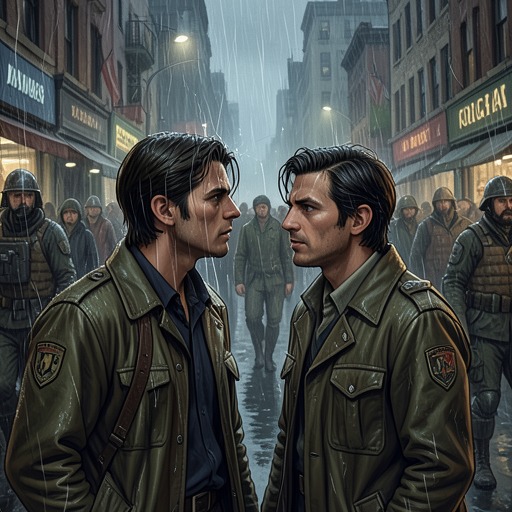
Jane recalls staying at the Americana Hotel in Bogotá on what she describes as a routine assignment for her employer. The workday had ended, and she was looking for a diversion when violence flared across the city. Politicians were being murdered, soldiers regularly stormed buildings, and police were ransacking rooms. News spread that the Barracuda, Sancho Varrón, had been shot, sending people screaming into the streets.
Inside the hotel bar, a bellboy warned John that police were rounding up tourists traveling alone. The warning gives the encounter its immediate stakes: being unaccompanied could make a visitor vulnerable to arrest amid the confusion, and the police captain who enters the bar soon begins seizing suspects and intimidating other people. Jane recognizes that he might send them to prison, where they could disappear without anyone knowing what had happened. The danger is not an abstract backdrop; it creates the need for the quick, convincing fiction that brings the two strangers together.
A Couple for the Captain
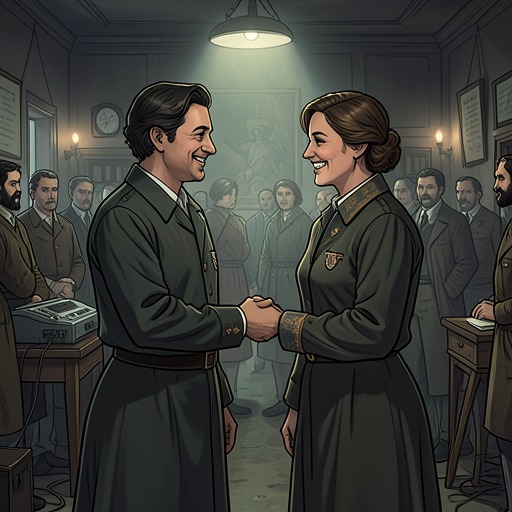
Jane steps toward John just as the captain notices her and looks between them. He asks whether they are together. They meet eyes, and Jane describes the exchange as enough: in the middle of deadly violence, a glance supplies the shelter that neither has time to arrange in words. John takes her arm as though he has been waiting for her all afternoon. Jane embraces him defiantly and leads him toward the stairs.
John’s account presents the same improvised escape from the other side. He sees Jane embrace him and draw him away while the captain watches, apparently jealous. The two keep up the charade on the way to her room, making their supposed relationship legible enough to deflect suspicion. Jane squeezes John’s hand as they climb. For the moment, the performance works: the captain turns his attention to frightening other innocent people, and the pair appear to have escaped his notice.
Their performance is both practical and charged with attraction. Jane remembers that, when she first saw John, she felt unable to look anywhere else. Yet the scene does not pause to establish a romance before the danger intervenes. Their closeness is simultaneously a disguise, a means of avoiding arrest, and the first physical expression of a connection that will become consequential. The exchange of looks and the borrowed gestures do the work of both flirtation and self-preservation.
Gunfire and Refuge
A burst of gunfire changes the plan before the pair reach any safety beyond the hotel room. They dive inside, shut the door, and sit side by side with their backs against it. From that position they listen to shouting, shots, and heavy footsteps outside, waiting to learn whether they will be among the lucky ones. The imagined ease of the flirtatious escape gives way to immediate, bodily fear: the closed door is their only barrier between themselves and the violence moving through the building.
John expects his new companion to scream, faint, or burst into tears. Instead, Jane giggles like a little girl excited by a game of hide-and-seek. The contrast makes her response striking without removing the danger around them. Their refuge is precarious, but the shared ordeal also gives the encounter a private, almost playful register. In a city where strangers may be swept up by police and gunfire sounds beyond the door, Jane’s laughter becomes the scene’s unexpected counterpoint to panic.
Significance and Later Echoes
The episode establishes the pattern at the heart of Jane and John’s relationship: performance is not separate from intimacy but one of the ways they enter it. Their first apparent couplehood is an emergency invention, a way to survive a police sweep; it becomes the origin story of a marriage whose domestic life will later be troubled by withheld truths and secret identities. In Bogotá, the fiction succeeds because they act together without needing to negotiate every step. The same ease of coordination, set against the violence surrounding them, makes the meeting feel at once romantic and tactical.
The book’s later scenes echo that collision between ordinary play and lethal danger. Years into the marriage, John’s teasing use of a tiny grenade made to resemble a toy turns a familiar domestic game into a real threat. During the house shootout, gunfire destroys Jane’s treasured teapot and kettle along with her kitchen. At the home-goods store, the couple’s attempt to deal with an undercover agent becomes a public firefight when the armed mascot Homey springs from a bin of teddy bears. These later incidents do not belong to the Bogotá encounter itself, but they sharpen its significance: from the beginning, the pair’s closeness is formed in situations where a game, a performance, or a household object can sit beside genuine danger. The hotel-room refuge is the first instance of that uneasy blend, and the beginning of their shared story.